Monday, August 17, 2015

Purdue University

I think it's pretty clear from this website that I love visiting college campuses. However, I have a special fondness for schools in the Big Ten Conference, which includes the subject of today's posting, Purdue University in West Lafayette, Indiana. Following my late-June swing through several Chicago schools (see postings below), I was fortunate to be able to fit in a trip to Purdue, combining business and pleasure.


Purdue is best known academically for science and engineering, including a rich history with the space program. As you'll see, the campus is very green, with lots of tradition. Reminders of the school's athletic nickname, the Boilermakers, in terms of railroad and steelworker imagery are seemingly everywhere. The adjoining commercial district appears smaller than those in other Big Ten towns such as Ann Arbor and Madison, but there are still plenty of places to get some pizza and other favorite foods of college students. Photos of all these Purdue features -- and more -- are shown in the sections below.

Engineering and the Space Program

On the north end of campus sits Purdue's engineering complex, featuring the Gateway to the Future arch.


Neil Armstrong (1930-2012), the first person ever to set foot on the moon, is a Purdue alumnus and accordingly is featured prominently on the campus.  There is a Neil Armstrong Hall of Engineering (whose design borrows a little too much from the In-N-Out Burger logo for my taste)...


...with a statue of Armstrong in front.


In addition, Armstrong's famous quote upon walking on the moon is depicted on the plaza near the statue. I lacked the photographic equipment to capture the full quotation in one shot in a way that would be readable (this photo I found online doesn't portray a fully readable quote either). Therefore, I photographed the quote in four parts, which allowed me to get close to each part. I then cropped each part and stuck the parts together after the fact. The background is a schematic of the plaza. The final product looks pretty amateurish, I know, but at least you can read the full quote (especially if you click on the picture to enlarge it).


(As a side note, the "a" in "One small step for a man..." is of questionable audibility in the recording of Armstrong's statement. You can check for yourself from an audio clip on the Wikipedia page for Neil Armstrong. As many observers have pointed out, without the "a," then "man" in that context is conceptually equivalent to "mankind" at the end of the quote, ruining the distinction Armstrong was trying to create.)

In all, nearly two dozen Purdue alumni have served as astronauts, including such well-known ones as Gene Cernan and Gus Grissom. An official list appears here, from which it can be seen that all majored in engineering or closely related scientific fields.

Another part of the vast engineering complex is the Materials Science and Electrical Engineering building...


Basketball's John Wooden

Not too far from the area recognizing Armstrong is a monument, of sorts, to another famous Purdue alumnus, the legendary basketball coach John Wooden. In 2010, the university named a street on campus after him, John R. Wooden Drive. I took a picture of the street sign and added it to the Wikipedia page for John Wooden (see "Honors" section).

Student Union

The Purdue Memorial Union (below) has many features common to Big Ten student unions, including a bowling alley (not shown), a hotel (shown on the right)...


 ... and traditionally appointed meeting/study rooms.


Among the food-service options in the Union is Pappy's Sweet Shop.


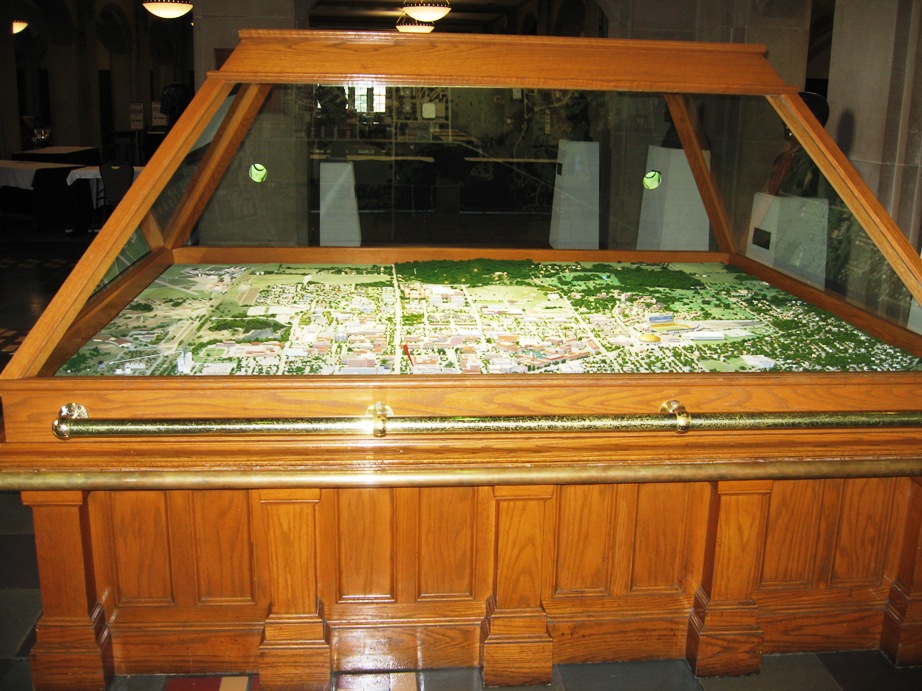
Another neat feature, located in the lobby, is a detailed model of the campus, shown first with its case and then through the glass for more of a close-up.


Other Parts of Campus

Expansive lawns, towers, statues, sculptures, and fountains abound on the Purdue campus. My favorite is the "Unfinished P," which symbolizes that learning is always a work in progress.


Another popular feature is Loeb Fountain, also known as the "Walk-In Fountain." On the day I went by this fountain, a number of families had brought their children to escape the heat.


Next to Loeb Fountain is Beering Hall (Liberal Arts and Education)...
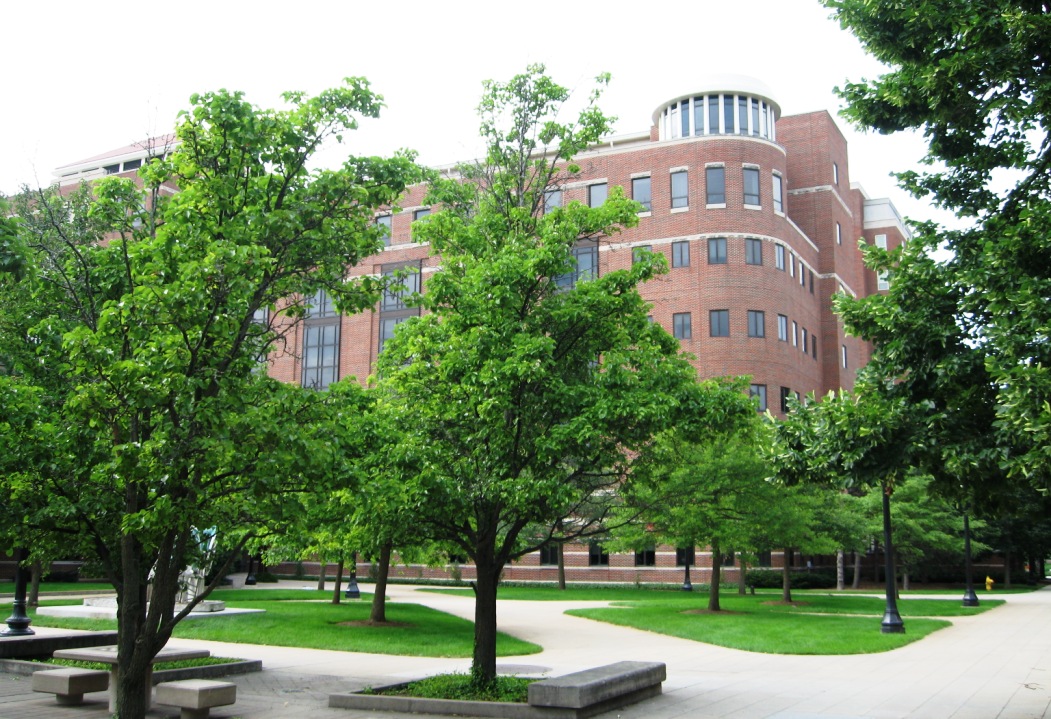

The Purdue Bell Tower (sometimes also referred to as the Clock Tower) stands within a large grassy area...


Elsewhere, picnic tables are available for enjoying the verdant setting...


Some of the additional academic buildings that caught my eye include the new Bailey Hall for music...


...and Pfendler Hall (Agriculture)...


A lunch spot apart from the Union is the Boiler Bistro. I wonder if the menu includes a Boilerplate? Purdue is one place "boilerplate" presumably would not be a pejorative!


Adjoining Town/Commercial District

One thing Purdue/West Lafayette has in common with Ann Arbor and Madison, however, is that the main drag is State Street.


The bookstore is just off-campus on State Street...


Two venerated establishments nearby are Harry's Chocolate Shop (actually a bar; notice the neon beer logo on the right of the lower picture)...


...and Triple X (or Tri-Chi), actually a burger place...


I'm always on the lookout for some good plain-cheese pizza and Mad Mushroom (known as "Mad Mush") filled the bill...


There's a lot of new-apartment construction taking place a few blocks from campus, perhaps signaling enrollment growth...


All I can say at this point is "Boiler Up!"

Sunday, August 02, 2015

University of Chicago

Today's posting closes out my four-part series (displayed sequentially below in separate postings) of visits to different Chicago college campuses during my late-June trip to the Windy City.

Situated in the South Side neighborhood of Hyde Park, home to President Barack Obama, is the University of Chicago. Before we get to the pictures I took in late June, this online self-rotating slideshow provides an aerial shot, showing the U of C's location relative to downtown Chicago. Even though the photo makes the university seem adjacent to downtown, in reality it is seven miles south.

U of C is an elite academic institution, on a par with Harvard, Yale, Stanford, and others of that echelon. According to the Wikipedia, "89 Nobel laureates have been affiliated with the university as visiting professors, students, faculty, or staff, the fourth most of any institution in the world. In addition, Chicago's alumni include 49 Rhodes Scholars, 9 Fields Medalists [an award for top mathematicians under age 40], 13 National Humanities Medalists and 13 billionaire graduates."

Chicago does not appear to be as well-known to public as other elite schools, however, perhaps because it does not compete in Division I athletics. Chicago once did, as a member of the Big Ten conference. The first Heisman Trophy winner, Jay Berwanger, played for U of C, and one of the all-time great football coaches, Amos Alonzo Stagg, plied his trade there. In the 1930s, however, President Robert Maynard Hutchins eliminated football, claiming it to be incompatible with scholarly excellence (the sport was later restored at the lower-key Division III level).


The architecture alone is a treat at U of C, the Collegiate Gothic style all around. The history of the style is reviewed in this article, entitled "How Gothic Architecture Took Over the American College Campus."

To the left is Lawson Tower, part of the former Chicago Theological Seminary and now part of the conversion to the Saieh Hall for Economics (including the Becker-Friedman Institute for Research in Economics). Further architectural and historical background on Lawson Tower is available here.

Below is the Rockefeller Chapel (the university's founding was aided by the financial contributions of John D. Rockefeller), showing two wings of the building. The Chapel hosts a number of events, as detailed on its homepage. A beautiful shot of the interior is available here.


Among the more modern structures at U of C is the Oriental Institute Museum, a virtual tour of which is available here...


Nearby is the Main Quadrangle, combining lush lawns and gardens with yet additional attractive architecture (Eckhart and Rosenwald Halls are shown below)...


Traveling west, one exits the Quad by walking through a tunnel on the first floor of Edward H. Levi Hall. Levi was a legal scholar, U of C president, and Gerald Ford's U.S. Attorney General in the aftermath of Watergate (Wikipedia page). Levi Hall is the main university administration building, rededicated in his honor in 2013.


Upon exiting the Quad through the Levi passageway, one finds the U of C bookstore...


While I was in the bookstore, the previously moderate rain showers escalated into a torrential downpour, and I ended up getting soaked as I walked back to the Metra train to go back downtown. Still, it was a great experience!

Saturday, July 25, 2015

Loyola University Chicago

On the far north side of Chicago, up against Lake Michigan...


...along the elevated "El" train system (with some fancy new apartments or condos being built in the background)...


The Loyola U. Chicago campus offers extensive signage as to where you are...


Driving north on Chicago's famous Sheridan Road, one encounters a high-traffic, winding passage through LUC.


Here are two views of the campus sign at this turn.


The gray high-rise around the turn is the Mundelein Center (below). The building was part of the former Mundelein College (1929-1991) for women, which was absorbed by Loyola. I remember that when I was a kid in the early 1970s and my maternal grandparents lived on Sheridan, my Uncle David would take me to run around the track at Mundelein when I visited Chicago.


The interior of the campus contains some new construction, such as the Quinlan Life Sciences Building...

...along with some older structures featuring a distinctive architectural style...


LUC is an attractive and easy-to-reach campus, worth a visit from campus aficionados. 

Friday, July 10, 2015

University of Illinois at Chicago (UIC)


The University of Illinois system includes, in addition to its flagship campus in Urbana-Champaign and a smaller campus in the state capital Springfield, a big-city campus in Chicago (UIC). Located just west of the downtown Chicago Loop, UIC has a very urban feel. Upon arriving at UIC via subway, one then follows a path to the campus along an expressway overpass (shown above). Further, the campus is almost literally in the shadows of downtown's skyscrapers, including the Willis Tower (better known by its former name, the Sears Tower).


Some of the buildings have a "concrete jungle" look, amidst the green of campus lawns, as shown in the next two photos.


UIC also has some public art, however, to improve the aesthetics of the setting.


Also, within the Student Center, there's an interesting looking student lounge (I'm not sure if it's retro or futuristic!).


To my mind, the most important structure on the UIC campus is Jane Addams's Hull House, most active from 1889-1935 from what I can gather, and now remaining only as a museum (official website, Wikipedia page). Described as providing "innovative social, educational, and artistic programs" for recently arrived immigrants in the neighborhood, Hull House also served as a launching pad for social reformers and activists to formulate policy ideas.


The Hull-House complex long predated UIC in its Near West Side location. In fact, construction of the present UIC campus in the 1960s required demolition of most of the Hull-House complex. According to this 1994 Chicago Tribune article:

In 1963, the Hull House Association sold its 13-building complex, all on the 800 block of South Halsted, to the City of Chicago as a prelude to construction of UIC. Eleven buildings fell to the wrecker's ball. Only a national protest saved the remaining two, the former mansion of real estate dealer Charles Hull and the Residents' Dining Hall.

Sunday, July 05, 2015

Roosevelt University (Chicago)

I've just returned from a trip to Chicago and other parts of the Midwest, so I'll be posting a bunch of campus-based photo essays in the coming days. I photographed four Chicago campuses on this trip, which, combined with previous entries I posted from Northwestern (2002) and DePaul (2010), will give us six Chicago universities total (seven, if you count the more-distant Northern Illinois University).

Today's entry is a brief one on Roosevelt University, located in the heart of Chicago's downtown business and park (Millennium and Grant) districts at 430 S. Michigan Ave. Roosevelt is actually more of a high-rise office building (the front of which I photographed, below) than a traditional campus, but in a sense, all of downtown Chicago is its "campus."


This article shows some of the futuristic architecture on Roosevelt's higher levels as the university has grown. It also tells an interesting story of how the university was formed in a breakaway act of protest in 1945 by the president, faculty, and staff at another institution. According to the article:

Moved by their actions, Eleanor Roosevelt allowed the new school to be named after her and the late President Franklin Roosevelt who had died just two weeks after they received a charter.

Roosevelt University also has personal meaning to me, as my mother attended college there for part of her education.