Tuesday, November 22, 2022

University of Minnesota (2022)

I just returned a few days ago from an academic conference in Minneapolis. During this trip, I photographed some parts of the University of Minnesota campus. The Twin Cities are very cold in general -- why else would downtown Minneapolis feature an enclosed Skyway system of bridges that allows people to walk between buildings without having to go outdoors?


During my visit, however, it was extra cold. Whereas the average high for November in Minneapolis is 41.9 F., during this trip the daily highs were in the teens and twenties. Undaunted, I took the metro rail from downtown Minneapolis to the campus (East Bank side of the Mississippi River).


Goldy Gopher, the university mascot representing Golden Gopher sports teams, is ubiquitous on campus. Near the Coffman Student Union is this statue...


The Student Union is a traditional-looking building...


Inside, Minnesota has one of the nicest-looking bookstores I've ever seen, down the escalators in the basement...


Facing the Student Union across a large open lawn, is Northrop Hall, the university's performing arts center...


In between the East Bank rail station and the Coffman Student Union are a stretch of buildings in the biological sciences. One is Molecular and Cellular Biology, with the cute model of chemical bonds in front...


Next, with its clock tower and enclosed walkway is Jackson Hall (left). Jackson hosts the Department of Genetics, Cell Biology and Development...


Finally along this stretch is Nils Hasselmo Hall, home to departments such as Biomedical Engineering.


Given the weather, I didn't explore the campus as much as I would have liked. I took one last picture of Goldy (adorning a Gopher Trip bus)...


...and a picture of the Minneapolis skyline as seen from the campus...


... before heading back to my conference.

Friday, June 10, 2022

University of Hawai'i

Sothy Eng, an outstanding photographer who received his Ph.D. in Human Development and Family Studies with us at Texas Tech University and is now a faculty member at the University of Hawai'i at Manoa, sent me some pictures of the UH campus a while back. I display these photos below. The university, located in Honolulu, is the flagship campus of the University of Hawai'i System. 

Shown first is Hawai'i Hall, UH's first permanent building. Hawai'i Hall underwent a major renovation in 2003 and hosts administrative offices for the university.

Some of the other buildings were hard for me to identify from Internet searches, but what follow are my best guesses. Next are the College of Natural Sciences, Krauss Hall (Pineapple Research Institute and John Young Museum of Art), and Webster Hall (School of Nursing and Dental Hygiene), respectively.


Public art on the UH campus includes the following statue, known as "The Fourth Sign"...

Lastly, UH is known for its amazing variety of trees. Below are some examples...


Wednesday, March 16, 2022

Rice University

My good friend Dr. Mike Gustafson was down in Houston to do the radio broadcast of this past weekend's Texas Tech at Rice baseball series. While there, he very kindly took a bunch of photos of the tree-lined Rice campus. They appear below. 

Rice University is an elite academic institution, nestled alongside Hermann Park and the city's art-museum and medical districts. 

Rice has many unique features. One is its small enrollment -- 2,600 undergrads as of 1987 -- although that will be changing. Another is the system of residential colleges, like Oxford, Cambridge, Harvard, and Yale.* Anyway, with no further ado, let's get to the photos!

At the heart of the campus is the main quad. Filling in the two ends of the quad are Lovett Hall (Administration)...

... and Fondren Library.

Behind Fondren Library is the Rice Memorial Chapel and Campanile.

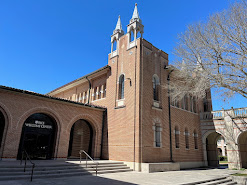
Rice also features various amenities, from the Welcome Center for prospective students and their families (below, left) to the Faculty Club in Cohen House (right).


According to the website Historic Houston, "In the early years the school’s strongest majors were science and engineering." Rice has expanded its profile in many other disciplines, however. Just in the past decade, the university has introduced many unique facilities in the arts, for example. These include the Moody Center for the Arts (opened 2017)...


and the James Turrell Skyspace (sometimes referred to as the Skyscape; 2012), a distinctive looking structure for exhibitions linking light, space, and music...


The roof is 72 X 72 feet and, as shown in this video, can be illuminated in different colors for different shows, with musical accompaniment.

Rice also hosts the Baker Institute for Public Policy, named after Bush-family associate and former U.S. Secretary of State James Baker (left), and the Jones Graduate School of Business (right).

Finally, we have a couple of the athletic facilities. Back around 1950, someone had the great idea to build a 70,000-seat football stadium for a school that enrolled only a few thousand students (and thus did not have a large alumni base, either). Thus is the origin of Rice Stadium. Other than its vast seas of empty seats on game day, it is a nice facility. As seen in the following photo (and in this aerial shot), long sections of stands run from end to end, ensuring that most seats are between the goal lines.


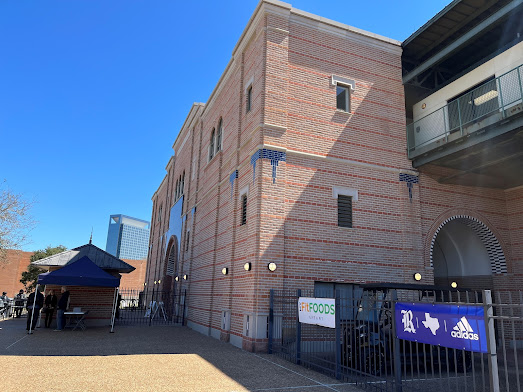
Rice's baseball program, while experiencing a surge of success in the late 1990s and early 2000s (including the 2003 College World Series championship), heavily revamped the old Cameron Field into the new Reckling Park. The following photo presents part of Reckling's exterior.

---

*I lived in Houston from 1989-1991 while on a postdoctoral fellowship at the University of Houston. I spent a lot of time at Rice during those days, attending talks and sporting events and just walking around. I never took any pictures on campus because (a) people didn't carry around phones back then with built-in cameras, and (b) I didn't know that, within several years, there would be the Internet and something called "blogs." Hence, I am grateful to Mike for taking these photos.

Wednesday, August 04, 2021

University of Illinois (2020)

It's been a while since I've posted! I have not travelled out of town during COVID-19 and only have some older photos to post. Today, I share some I took at the University of Illinois Urbana-Champaign during a visit in 2020. (There are also some Illinois photos taken in 2009 by guest contributor Erika Brooks that you can find listed in the right-hand column.)

Like many Big Ten schools, Illinois has an old-fashioned student union with lots of activities going on. The next two photos show the Illini Union from the front and back.


And by "activities" in the union, we mean bowling! 


The back of the Illini Union faces onto the Main Quad...


Opposite the union on the other end of the quad is the domed Foellinger Auditorium, which includes the largest lecture hall (capacity 1,361) on the entire campus. 


A picture of Foellinger's glorious interior is available here.

Finally, here in the Land of Lincoln, we have Lincoln Hall, also surrounding the quad.


A slideshow display of Lincoln Hall's interior is available here.

Monday, December 23, 2019

Yale University


Our new entry is the fifth from NYU professor John Jost's East Coast Collection. It depicts John's Ph.D. alma mater Yale University, one of the jewels of the Ivy League. Shown next among the gray skies and pink blossoms is Sterling Memorial Library.


Shown next is the Beinecke Rare Book and Manuscript Library, with its unusual grid appearance.


Fittingly, John captures the entrance to the Yale Psychology Department.


Lastly, we see a grassy quad. My best guess, from reviewing images on Google, is that it's Grace Hopper Hall. However, I could not find a definitive match.

Tuesday, August 20, 2019

UCLA -- Revisited in Its Centennial Year


The very first posting I did on this site, in 2006, was of my undergraduate alma mater, UCLA. I was back in L.A. a couple weeks ago and took some time to photograph UCLA again during its centennial year.* As shown in the following montage, banners adorn the campus, celebrating many of the university's accomplishments.


A lot has happened on the UCLA campus over the past 13 years. The basketball arena, Pauley Pavilion, was renovated during 2011-12 and, with the re-opening, a statue of legendary coach John Wooden was added.


UCLA also updated some of its academic buildings.


Shown above is the Hugh & Hazel Darling Law Library, which was ranked No. 20 among law-school buildings in the world. The law library, which involved a major expansion of the previous one, re-opened in 1998, so I guess I could have included it in my 2006 photo essay, had I thought to do so.


Next, we have the Herb Alpert School of Music, whose additions to the previous music department opened in 2014. According to the Alpert School's website, it is "The only school of music in the UC system." Alpert is a trumpet player in the smooth-jazz style, whose popularity peaked in the 1960s and '70s. Now in his eighties, he is still performing. He was also a major recording executive, with A&M Records (Alpert & Moss).

Drawing upon President Eisenhower's characterization of the U.S.'s military-industrial complex, I've long said that UCLA has a construction-industrial complex. This is especially so in the biomedical section of the campus, which I did not photograph. Because of all the construction, I always find it refreshing to go back to the original quad of the campus (shown below), with the four original buildings.


The building toward the back, with the two rectangular towers, is Royce Hall. On the far right-hand side of the photo is Haines Hall. The other original edifices (not shown) are Powell Library and Kaplan Hall (the Humanities Building, formerly Kinsey Hall for physics).

---
*UCLA was established in 1919, at which time it was located on Vermont Avenue, between Hollywood and downtown Los Angeles. In 1929, the university moved to its current Westwood location (the Vermont Avenue site became L.A. City College).

Sunday, July 14, 2019

Missouri State University

Frequent contributor Rebecca Oldham visited Springfield, Missouri a while back and took some photos of Missouri State University. As shown on this school seal, the institution was once known as Southwest Missouri State College. The school achieved university (instead of college) status in 1972, and then in 2005, the "Southwest" was dropped, yielding the current name (Wikipedia entry).

Shown first is the statue of mascot Boomer the Bear, in front of the Student Union. The Lady Bears basketball program has twice made the Final Four.


Shown next is Carrington Hall, the Administration Building.


Finally, behind the Student Union, is the aforementioned seal. To the left of the seal is Siceluff Hall (English), whereas to the right is Hill Hall (Education). Siceluff and Hill are parallel and don't actually intersect; my juxtaposition of the pictures just makes it seem that way.


As Rebecca mentioned, Missouri State has a very successful theatre arts program, whose graduates include John Goodman, Kathleen Turner, and Tess Harper.