Monday, January 24, 2011

Northern Illinois University


Located about an hour west of Chicago is the agricultural town of DeKalb, Illinois, home of Northern Illinois University. One of our Texas Tech doctoral students, Katie Gerst, received her Master's degree at NIU and had some photos of the school that she was willing to share. Shown first is the castle-like Altgeld Hall, the first building on the NIU campus, named in honor of the governor who helped with the founding of the university. Katie photographed Altgeld Hall from two perspectives.


Next is the Holmes Student Center. I think it's somewhat unusual for a student-union building to have a high-rise design (which is even more noticeable on the Center's website), which suggests a lot of office space and meeting rooms, but potentially a shortage of expansive commons areas. There is something called the Sky Room on the 16th floor that looks interesting, however.


The third building, Adams Hall, was a women's dormitory from 1949-1967, until being converting to an administration building.


Gilbert Hall, a residence hall in the past and perhaps on the verge of being restored to that role in the future, is the topic of current construction planning.


Still Hall, at one point a gym, appears to host facilities in media, technology, and engineering.


The Law School's Swen Parson Hall sports a traditional academic look.


Shown last among the campus buildings is Williston Hall; like other buildings seen thus far, Williston was once a dorm and now holds offices.

Finally, every college town should have at least one quirky, colorfully decorated business establishment in the area. Maybe I'm reading too much into the picture, but perhaps the corn stalk symbolizes the human spine, which Dr. Van helps straighten out for his patients.


Friday, December 03, 2010

West Texas A&M (Canyon, TX)

One of our Texas Tech graduate students, Kim Corson, gave me some pictures she took at West Texas A&M University in Canyon, Texas, while traveling in the region (Canyon is roughly two hours north of Lubbock). West Texas A&M had been known until 20 years ago as West Texas State University, before being annexed by the Texas A&M University system. (The flagship of the system is, of course, Texas A&M University in College Station, way in the southeastern portion of the state.)

The athletic mascot for WT A&M is the Buffalo, depicted prominently in this fountain complex (below).


The inverted nature of the fountain -- that water travels down instead of up -- matches the Inverted Fountain at my undergraduate alma mater, UCLA.

What I also found stunning in the WT A&M photos is the clock tower (and its reflection), with which I formed the following little triptych.


Other attractions on the campus, as described to me by Kim, include the Panhandle-Plains Historical Museum...


...with the adjacent T-Anchor Ranch log cabin (which was moved to its present site in 1975)...


...the Wind Engineering complex, which is set to receive the nation's largest wind turbine...


...and finally, this cobblestone-looking building which, according to Kim, was originally a dormitory and is now used for alumni relations.

Tuesday, November 23, 2010

University of Mississippi

Sarah Dale, one of my former undergraduate students at Texas Tech, posted some pictures on her Facebook page of a family trip to the University of Mississippi. With Sarah's permission, I'm reprinting some of her photos. Ole Miss, as folks commonly refer to the university, is situated in the small town of Oxford, Mississippi. Oxford's population is only 19,000, although according to one of the sources I read, the larger area including surrounding counties has a total population of about 300,000. Any good college town will have an adjacent student-oriented commercial district and Oxford is no exception, with The Square (below).


I assume Square Books actually sells rectangular-shaped books. Also on The Square is the music club, the Lyric Oxford.


Information on The Square in Oxford is available at this link (when the page comes up, scroll down below the hotel information). The following building would certainly fit in architecturally on a college campus, but it actually appears to be the Lafayette County Courthouse.


Attending a football game appeared to be one of the Dale family's main priorities on the trip. Shown below is the Ole Miss Walk of Champions, through which the Rebels proceed into the stadium a few hours before kick-off.


Texas Tech football coach Tommy Tuberville, who previously held the same position at Mississippi, instituted the new "tradition" of Raider Walk upon his arrival earlier this fall in Lubbock. Finally, it's game time at Ole Miss...

Saturday, November 06, 2010

University of St. Thomas (Downtown Minneapolis Professional Campus)

Downtown Minneapolis, Minnesota, which I visited recently for an academic conference, features not only the traditional shimmering skyscrapers...


...but also quirky features such as a building with an entire wall painted like a musical score...


....and a statue commemorating the Mary Tyler Moore Show of the 1970s, the storyline of which was that her character, Mary Richards, worked in a Twin Cities television newsroom. As those of a certain age will recall, the opening sequence accompanying the theme song culminated in Mary tossing her hat in the air in a moment of joy.


In terms of colleges, the only one I was aware of in the immediate downtown area is the professional-school campus of the University of St. Thomas (whose main campus is in St. Paul). Shown below is the Opus College of Business and environs. Note the linkage of buildings by enclosed bridge/walkway, an extensive network of which exists in the downtown area to shield workers and visitors from the city's brutal winters.


I had hoped to also visit the nearby University of Minnesota campus, but ran out of time. For those interested in the University of Minnesota, we have a couple of photographs taken by my colleague Kazuko Behrens and displayed previously on this blog.

Monday, October 25, 2010

Virginia Tech

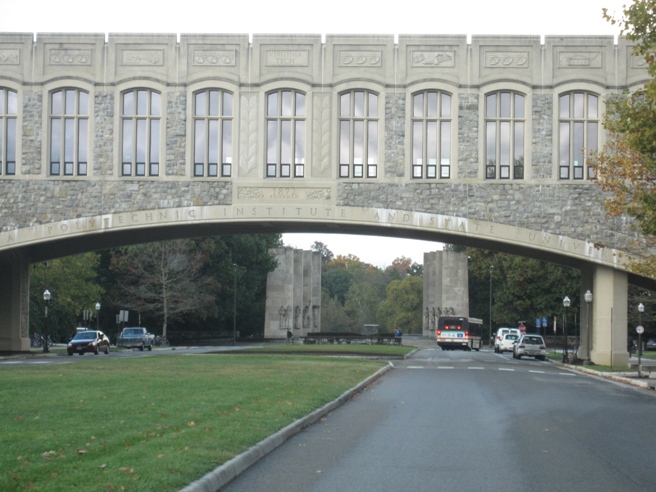
Frequent contributor Jackie Wiersma recently sent me some photos she had taken at Virginia Tech (officially the Virginia Polytechnic Institute and State University). Shown first is Torgersen Hall, described by Jackie as "what you drive under when you enter the campus." If you look closely at the arch below the windows (and clicking on the photo to enlarge it would help), you can see the full name of the institution inscribed.


Next is Burruss Hall, the administration building.


Burruss Hall is one of the buildings surrounding the central campus lawn, known as the Drillfield.


Also by the Drillfield are two memorials, the War Memorial Chapel...


...and the April 16 Memorial, commemorating the Virginia Tech Massacre that occurred on this date in 2007.


Finally, and on a lighter note, we have the football stadium, without which a Jackie Wiersma campus montage would be incomplete.


Monday, September 27, 2010

University of Arkansas

Jackie Wiersma, a 2008 graduate of our Ph.D. program at Texas Tech who has contributed photos from several campuses she's visited, provides us with some from the University of Arkansas (in Fayetteville), where she has just begun a faculty position. Shown first is the north tower of Old Main, the oldest building on campus and currently home to the College of Arts and Sciences and other academic units.


Next is the Home Economics building (note the engraving above the doors, which is easier to see if you click on the photo to enlarge it), where Jackie is based in the School of Human Environmental Sciences and Department of Human Development and Family Science.


In addition to the usual campus mainstays of the library (top) and student union (underneath)...


...the Arkansas campus also has some unique features. These include the Fulbright Peace Fountain (which the university captures with a live webcam)...


...the Greek Theatre (a gift to the university from the Chi Omega sorority)...


...and the Senior Walk, which is unlike anything I've ever heard of in American (or any other country's) higher education. According to a university document about Senior Walk: "Starting with the first class of 1876, every graduate’s name is etched into a concrete sidewalk that winds around campus for more than five miles." If you enlarge the picture and look carefully at the sidewalk by the lamppost, you should see an upside down "1914," where that year's graduates are listed.


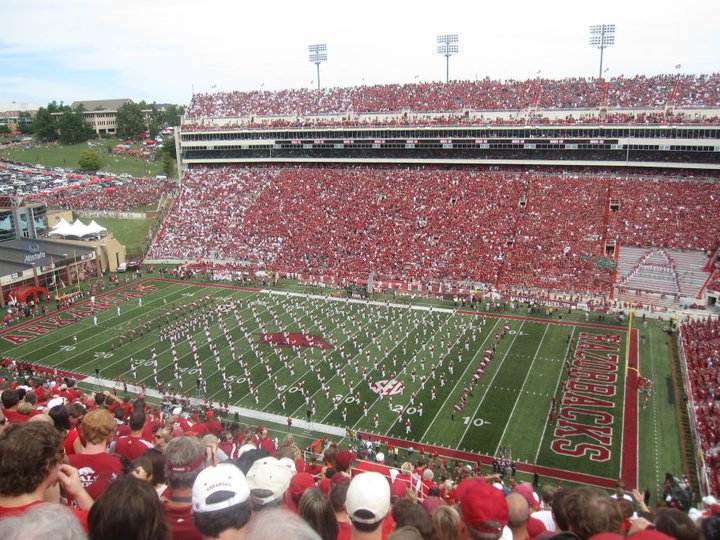
Finally, we have two photos of the football stadium, one from the outside and one from the inside. If you know Jackie, you know that football is a passion of hers! On this day, the home Razorbacks narrowly lost to last year's national champion, Alabama.


Friday, August 06, 2010

University of Koblenz-Landau (Germany)


Although the name of this website is "America's College Campuses," I'm in no way opposed to showcasing universities from throughout the world. It's just that neither I nor my colleagues seem to get to international campuses that often. My wife and I recently were in Germany, however, visiting her family, so I'm now able to feature the first campus from outside the U.S. on this blog. It is the University of Koblenz-Landau campus in Landau, where my wife's father taught for many years before retiring.

UKL has been characterized as "one of the youngest universities in Germany." Below are photos of the typical landmarks of a college campus, namely the library, academic buildings, and the student union. Consistent with the campus's modern architechture, many of the buildings feature extensive use of glass, making for a bright, sunny atmosphere (as long as the weather cooperates). Extensive green foliage also lends the campus a little bit of a more traditional look.


Monday, May 17, 2010

DePaul University

A couple of postings ago (April 3, 2010), I alluded to DePaul University in Chicago's Lincoln Park neighborhood as exemplifying a community that, I felt, had a unique college-town feel amidst the larger city. Last week, I was in downtown Chicago for an academic conference, so I decided to take the "L" (short for elevated trains) up to DePaul (Fullerton Ave. station). DePaul also has professional schools downtown, but I focused on the main Lincoln Park campus (see this three-dimensional map of all campus buildings). Signage is plentiful, both for the university and the surrounding community.


An interesting juxtaposition of traditional and modern is the university's Concert Hall (formerly the Chapel), which has a solar panel nearby for alternative energy purposes (shown by the third column, going left to right, of the building's facade).


Another attractive area on campus is known as The Quad and St. Vincent's Circle. I took two photos of this area, one from a distance and the other (the insert) closer to the Circle.


Most buildings on the DePaul campus are constructed in an attractive red-brick style, but the school is not exempt from what I call the "concrete jungle" appearance (an architectural style known as "brutalist").


An oddity of the campus is L train running through it, here by an athletic field.


Talking about sports, DePaul and the city of Chicago named a street on campus (on an honorary basis) for legendary former Blue Demon men's basketball coach Ray Meyer.


DePaul is situated in what is primarily a residential area, and a very nice one at that.


There are also, however, student-oriented businesses near campus (cafes, bars, T-shirt/memorabilia shops, etc.) that are characteristic of college towns. Here are some photos I took in the neighborhood south of campus (shown at the very bottom is the intersection of Webster and Halsted).