Sunday, September 08, 2013

University of California, Davis

Yoojin Chae, a faculty colleague of mine at Texas Tech who did post-doctoral research at UC Davis, went back to visit at the northern California school late this summer. The town of Davis is located near Sacramento, the state capital. Yoojin was kind enough to take some pictures of the campus, which are shown below.


The first one displays the school seal, embedded in the ground near the Memorial Union. The Union building looks pretty modern, having gone through many renovations over the years.

\

An unusual campus tradition is the set of Egghead art sculptures, five in all, around campus. The one pictured immediately above is adjacent to the Shields Library; this particular sculpture is known as Bookhead.

Greenery is also a major part of the UC Davis campus. The two following pictures are from the Quad... 


...and the Arboretum, a 100-acre spread located south of campus.


According to the book The American College Town (which I reviewed here), Davis is famous for its environmental conservation efforts, such as product recycling and bicycle lanes. In the picture below, the sign in the upper-right corner warns bicyclists, who apparently are a major presence on campus, to yield to pedestrians.


Tuesday, August 20, 2013

Philadelphia-Area Schools II: Drexel University

Drexel University may not be as well-known nationally as its next-door neighbor, the Ivy League University of Pennsylvania (profiled here). However, Drexel has been growing vibrantly in its physical plant, enrollment, and endowment. The school has really strengthened itself in the area of professional education and features a co-op/internship program that blends college education with work experience. And like Penn, Drexel enjoys a spectacular view of Center City (downtown) Philadelphia, to the east.


Once on the campus, it almost looks like a venue for Harry Potter and his Hogwarts buddies, with Drexel's ubiquitous mascot, the Dragon...


Like virtually all campuses, Drexel features a mix of old and new buildings. A prominent, though not necessarily attractive, structure is University Crossings, a housing facility...


On the newer side, a building seemingly nearing completion is the Papadakis Integrated Sciences Building. In addition to its interesting exterior, the PISB will feature a "Bio Wall," which is said to enhance energy efficiency and air quality (see here and here).


Another building in the finishing stages with a funky design is the LeBow College of Business...


Finally, we have Drexel's Earle Mack School of Law, on busy Market Street...


The Law School, which was established in 2006, will soon implement an option for students to obtain their law degree in two years, along with the traditional three-year law curriculum. The explanation of the two-year option on the Drexel Law webpage fits with the university's aforementioned work/career orientation: "You can begin practicing law sooner. And you’ll be a step ahead on your career path."

Sunday, August 11, 2013

Philadelphia-Area Schools I: University of Pennsylvania ("Penn")

Situated to the west of downtown Philadelphia just across the Schuylkill River, the University of Pennsylvania blends old-style architecture and verdant fields on its Ivy League campus. Also, as discussed further down, Penn is home to two of the most storied athletic facilities in the U.S.

Entering Penn from its northeast corner (33rd and Chestnut streets) after crossing the street from neighboring Drexel University, as I did, one encounters a walkway in the area of Hill Square and Hill College House. Here's a Penn map to help orient oneself to the campus.


If one were to walk along the grass to the right (west) of the walkway, one would find Silverman Hall, home of Penn Law School.


Walking south on 34th St. from in front of the Law School brings us to Irvine Auditorium, a performing-arts facility with a spire-type architectural style, at the corner of 34th and Spruce.


Spruce St. forms the northern border of Penn's medical/hospital complex, a mark of distinction for the university as Penn created the nation's first medical school. The following montage highlights Penn Medicine.


The "classical" looking building in the lower right of the montage is the Hospital of the University of Pennsylvania (HUP), located right on Spruce. Further south are the Smilow Research Center and Penn Tower (the latter combining medical offices and hotel rooms for families of patients at the nearby hospitals). The Children's Hospital of Philadelphia, which forms the unfortunate acronym CHOP, is also in the area.

Near the medical facilities, along Penn's eastern edge, are the two athletic facilities I alluded to. Shown first is Franklin Field, home to the Penn Quakers football team and also to one of the world's premier track meets, the Penn Relays, held every spring. A statue of Benjamin Franklin stands outside Franklin Field (I used different brightnesses on the statue of Franklin and on the podium, in order to make each stand out as sharply as possible).


Next door is the Palestra, home to Penn basketball and other indoor sports (on the day I visited, the floor was configured for volleyball). What makes the Palestra famous is that it not only hosts Penn basketball games, but also used to host contests between any two "Big 5" Philadelphia college rivals -- Penn, LaSalle, St. Joseph's, Temple, Villanova -- who happened to play each other (see this Big 5 historical website). In more recent years, however, whenever two of the schools other than Penn have played each other, the games have usually been played on one of the schools' campuses. This upcoming season, for example, LaSalle will be playing Villanova at Villanova's campus and St. Joe's will play Temple on Temple's campus. The Palestra also has a tradition of fans throwing streamers on the court after their team scores its first basket.


Finally, heading back toward the north end of campus, there are at least two more locations of note. One is Locust Walk (named after the street, and perhaps locust trees, but presumably not locust insects). Locust Walk is a major pathway on campus, leading to its western edge.


The other is the Penn Bookstore, a huge multi-story facility. To the left in the montage below is the bookstore along Walnut St, and to the right is the cylindrical foyer at the corner of Walnut and 36th.


Sunday, June 02, 2013

Viterbo University (La Crosse, Wisconsin)

Viterbo University is a Catholic Church-affiliated institution of roughly 3,000 students. According to Viterbo's Wikipedia page, the school has been around for over 100 years in different forms. At first, it  was not college level, then became a junior college, a four-year college, and finally a Master's granting institution. The training of teachers has always been a major emphasis at Viterbo. In addition, Viterbo has a cooperative arrangement with the University of Wisconsin-La Crosse, which allows for cross-enrollment possibilities.

One of our Texas Tech graduate students, Violeta Kadieva, received her undergraduate degree at Viterbo. She recently was back visiting in Wisconsin and kindly took the following photos for this website.


 The first photo appears to be of the Marian Hall student residence.


The second photo appears to be of the Murphy Center, as corroborated by another photo (in snowier times), available online.


The third shot might also be of the Murphy Center, based on the red brick exterior and placement of the windows.

Saturday, September 15, 2012

York College of Pennsylvania

This past week, I gave an invited all-university address at York College, on the topic of college-student drinking. York is in southeast Pennsylvania, about two hours west of Philadelphia and an hour north of Baltimore, Maryland. The dominant visual aspect of the York campus is the color green. Not only are the school colors green and white, but also the campus and surrounding region feature vivid green lawns and foliage. (York's athletic teams are known as the Spartans, meaning they have the same colors and team name as Michigan State.) Following are some photos of the York College grounds...


One of the most popular places on campus is the Green Rock. According to this page on York College traditions, "Following commencement, the graduating class gathers to write their names and messages in white on a large rock painted Spartan green known as the 'The Rock' and 'Old Spart.' The students' signatures remain on the rock until the next commencement when it receives a fresh coat of green paint."


Finally, we have Wolf Hall, the campus facility for music, art, and communication, in which I gave my talk. Below is Wolf from the outside, the DeMeester Recital Hall from the inside, as the audience gathered, and me, as I began my presentation.


Sunday, September 04, 2011

Lehigh University (Pennsylvania)

Sothy Eng, who received his Ph.D. with us at Texas Tech and then did a post-doctoral fellowship at UCLA, has settled into his new position at Lehigh University. Sothy is a great photographer and has been kind enough to share some of his work here at America's College Campuses. Some of his Lehigh photographs are available here. Here's a screenshot providing an overview of Lehigh.


Sunday, August 07, 2011

Bowling Green State Univ. (Ohio)

Bowling Green State University (BGSU) sits in northwest Ohio, a little over 20 miles south of the city of Toledo. For the last 10 miles of the trip southward, extensive farmland leads down to BGSU.


The University likes to display its initials and Falcon logo throughout campus, via shaped hedges and banners in the school colors of brown and orange.


Many of the academic buildings appear to be undergoing renovation, such as Williams Hall, which hosts a number of social-science disciplines. Note also the brown/orange shade of the bricks.


Much of the campus consists of green spaces, literally as in the case of this lawn...


...along with eye-catching designs such as the huge mural on one side of Jerome Library. Near the library is BGSU's Carillon Bell Tower, which looks similar, in my view, to the one at University of Illinois, Urbana-Champaign.


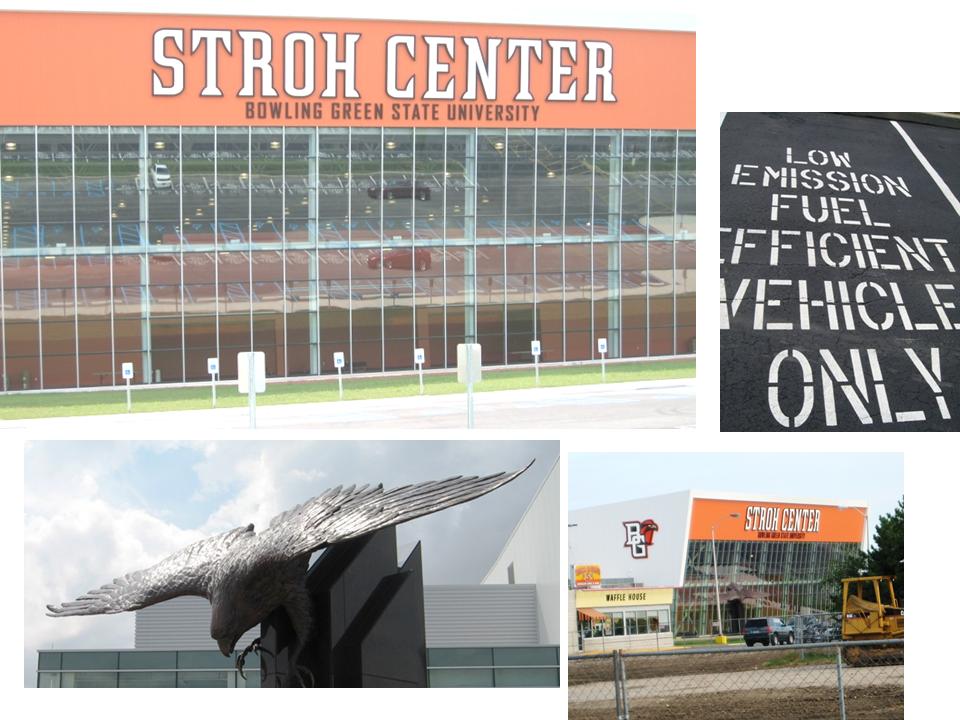
Beginning this Fall term, BGSU basketball and other indoor teams will have a new home, the Stroh Center, on the front edge of campus. Immediately in front of the new arena are the Falcon statue (lower left in the following montage) and, in a "green" gesture, a number of parking places reserved for cars with desirable environment properties.


I am used to the campuses and adjoining commercial districts at Midwestern (Big 10) schools such as Michigan, Wisconsin, Minnesota, Northwestern, Indiana, and Ohio State being easily walkable. Despite being in the same region as these institutions, BGSU (a member of the Mid-America Conference) seems considerably auto-centric, as a car appears necessary (or at least helpful) to navigate the wide streets and highways surrounding the campus.

Monday, July 11, 2011

UMass Amherst

Nestled in western Massachusetts is UMass Amherst, the flagship of the University of Massachusetts system. Hal Grotevant, a UMass professor, posted some pictures on Facebook that he had taken on campus, and he has kindly agreed to let me repost them here. [You may need to click the area where each photo goes, to view the photo.]

In the background is the iconic Old Chapel, a structure that apparently is badly in need of infrastructure repair.


Along with its quaint architecture, UMass also features more modern styles. Shown below is a montage of Tobin Hall, the psychology building.


UMass's W.E.B. Dubois Library, the tallest library in the U.S. at 26 stories, is famous for its falling brick chips. I had read many years ago that engineers had failed to take into account the weight of the books when calculating the physical strength requirements of the floors. The engineering flaw theory, however, may just be an urban legend. I visited UMass Amherst once, in 1996, and there were some areas outside the library that were fenced off to prevent pedestrians from walking where there may be falling brick.

Also in the realm of legends is the Minuteman Statue, shown next. Students apparently find the statue a source of good luck before exams. 


Lastly, we have the Campus Pond, a UMass landmark in warm weather and in cold.


Saturday, March 05, 2011

Western Michigan University

This is probably my most minimal entry, as the photos were taken aboard a (mostly) moving train in snowy conditions. Nevertheless, I have a shot of a Western Michigan University athletic facility (University Arena/Read Field House), as well as of the train station in Kalamazoo, Michigan.


Monday, January 24, 2011

Northern Illinois University


Located about an hour west of Chicago is the agricultural town of DeKalb, Illinois, home of Northern Illinois University. One of our Texas Tech doctoral students, Katie Gerst, received her Master's degree at NIU and had some photos of the school that she was willing to share. Shown first is the castle-like Altgeld Hall, the first building on the NIU campus, named in honor of the governor who helped with the founding of the university. Katie photographed Altgeld Hall from two perspectives.


Next is the Holmes Student Center. I think it's somewhat unusual for a student-union building to have a high-rise design (which is even more noticeable on the Center's website), which suggests a lot of office space and meeting rooms, but potentially a shortage of expansive commons areas. There is something called the Sky Room on the 16th floor that looks interesting, however.


The third building, Adams Hall, was a women's dormitory from 1949-1967, until being converting to an administration building.


Gilbert Hall, a residence hall in the past and perhaps on the verge of being restored to that role in the future, is the topic of current construction planning.


Still Hall, at one point a gym, appears to host facilities in media, technology, and engineering.


The Law School's Swen Parson Hall sports a traditional academic look.


Shown last among the campus buildings is Williston Hall; like other buildings seen thus far, Williston was once a dorm and now holds offices.

Finally, every college town should have at least one quirky, colorfully decorated business establishment in the area. Maybe I'm reading too much into the picture, but perhaps the corn stalk symbolizes the human spine, which Dr. Van helps straighten out for his patients.