Friday, April 13, 2007

Boston-Area Schools VI: Tufts University (Tina Brooks, Guest Photographer)

I didn't know it until I got back from my trip, but we actually can offer photographs of a sixth Boston-area college, Tufts University, which is located in Medford (north of Cambridge). One of our Texas Tech graduate students, Tina Brooks, attended the same academic conference as I did in Boston. As I later learned, Tina had gone to Tufts during her undergraduate years, and went back to visit on this recent trip. The photos below are hers, along with her descriptions of them.


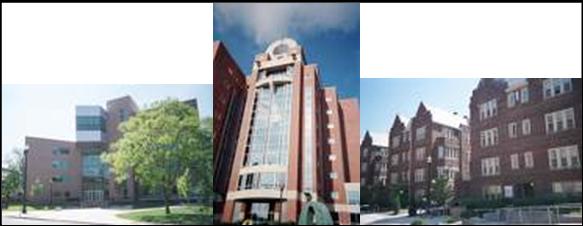
Shown above is a side entrance to the campus.


This is the library.


This is Goddard Chapel.


This is Carmichael Hall, a dorm and dining hall.


And, lastly, this is Richardson House, an all-female dormitory, where I lived in my freshman year.

Thursday, April 12, 2007

Boston-Area Schools V: Harvard

I closed out my tour of Boston-area colleges by taking a ride through Cambridge on a public bus route from MIT (see previous entry) to Harvard. Founded in 1636, Harvard is, according to a university history, the "oldest institution of higher learning in the United States."

From where a visitor would likely arrive on public transportation, one can enter the university through Harvard Yard. Perhaps most prominent among the buildings in Harvard Yard is the famous Widener Library, shown below.


As I walked through the Yard, quaint, picturesque buildings were apparent in all directions, as seen in the shots below.


Heading back out of Harvard Yard, one encounters Harvard Square, the touristy, commercial area by the campus. I took two photos in Harvard Square; they sort of fit together horizontally, like two pieces of a jigsaw puzzle, so I put them together to display (as you can probably tell, the "CAMBRIDGE SAVINGS" part of the sign at the top is from one picture, and the "BANK" is from the other; you might want to click on the montage to enlarge it).


Among other things, Harvard Square is the home of:

*The Harvard T (subway) station (on the red line, which is easy to remember, as Harvard's sports teams are known as the Crimson).

*Harvard's bookstore, the Coop (pronounced to rhyme with "hoop," not as "co-op"), the sign for which can be seen on the far right-hand side of the oval photo montage (above). The surrounding area, for several blocks, contains what has to be one of the highest concentrations of bookstores in the United States.

*A visitors' center, a newsstand, and miscellaneous other shops.

*An abundant presence of both foot and vehicle traffic.

If you ever visit Boston, an excursion to Harvard is a must!

Monday, April 09, 2007

Boston-Area Schools IV: MIT

On the final full day of my trip to Boston (March 31), I headed out with my camera and took the red line of the T out to Cambridge, home of the Massachusetts Institute of Technology (MIT, by the Kendall station) and Harvard University.

MIT's most iconic building appears to be the Great Dome (shown below). If you do computer searches on MIT and the Great Dome, you'll likely find a lot on "Hacks" (i.e., pranks) done in conjunction with the Dome, including putting objects on top of it.


Shown next is MIT's Wiesner Building, an I.M. Pei designed edifice that houses, among other units, the school's Media Lab.


Finally, in walking around MIT, one of the neatest things, in my mind, is the panoramic view of Boston you can get from the Cambridge side of the Charles River. In the shot below, you can see Boston's two skyscrapers, the John Hancock Tower (another Pei design) on the left, and the Prudential Tower on the right.

Thursday, April 05, 2007

Boston-Area Schools III: Berklee College of Music

The Berklee College of Music, which has absolutely no connection to the University of California, Berkeley, is located immediately west of the Hynes Convention Center in Boston, which is where the academic conference I attended was held.


I would guess that most Bostonians and visitors to town don't give a second thought to Berklee when they pass by its buildings. In my case, however, I took two courses in jazz appreciation at UCLA in the early 1980s as an undergraduate, so I was familiar with Berklee as the alma mater of numerous musicians.

According to this Wikipedia entry on Berklee:

At the time of its founding [1945], almost all music schools focused primarily on classical music. The original mission of Berklee was to provide formal training in jazz, rock, and other contemporary music not available at other music schools.

This emphasis on jazz and rock (including the "fusion" of the two) is illustrated by the following large display on one of the Berklee buildings.


Within jazz, my favorite instrument is the electric guitar. As seen on this list of Berklee alumni, practitioners of this instrument who went to school there include John Abercrombie, Al DiMeola, John Scofied, and Mike Stern. Another jazz guitarist, Pat Metheny, taught at Berklee as a 19-year-old, and later came back to give the commencement address.

Berklee's alumni stretch beyond the aforementioned musical genres, however, to include country. In fact, Dixie Chicks lead vocalist Natalie Maines, from my home base of Lubbock, Texas, received some of her training at Berklee.

Tuesday, April 03, 2007

Boston-Area Schools II: Boston College

If one were to get on a Green Line B train in the middle of Boston University (see prior entry below) and take it all the way west, one would end up at Boston College, in Chestnut Hill. On the hockey rink -- and probably elsewhere -- BU and BC are major rivals. Further, in contrast to BU's urban/commercial location, BC offers a more traditionally verdant and idyllic campus.


Entering BC from the T (train) stop puts one on the lower level of the multi-tiered campus, which among other things includes this student commons.


A fairly substantial hike up some stairs then took me to a busier part of campus. The next three photos were taken in O'Neill Plaza (on which BC features a live webcam). The first photo features an expansive view of the plaza (or at least attempts to). Seen in the distance is St. Mary's Hall.


Where the shadow is on the right-hand side of the above picture is the O'Neill Library, named after the former U.S. House Speaker. The library appears below.


Depicted last is Gasson Hall, perhaps the most famous building on the BC campus and located across from the library.


Getting to BC and getting around the campus make for a pretty formidable trek, but I would say it's worth it for aficionados of college campuses.

Monday, April 02, 2007

Boston-Area Schools I: Boston University

Boston is the state capital of Massachusetts, as seen below with the State House building in Boston Common. With its high concentration of colleges and universities, Boston also is arguably the U.S. capital of higher education, at least for private institutions.

I was recently in Boston for an academic conference and, during some free time, I rode around on the area's subway/streetcar system, known as the "T," visiting a number of institutions of higher learning. Riding "neath the streets of Boston," I got to Boston University (BU) and the Berklee School of Music within the city, Boston College (BC) in Chestnut Hill, and MIT and Harvard in Cambridge.


Today, I start off a five-part installment on Boston-area higher education with a brief photo essay on Boston University. BU is the quintessential urban university, nestled in near the major interesection of Commonwealth Avenue and Beacon Street, near the Massachusetts Turnpike. Along with BU, the area features Fenway Park, home of the city's beloved Red Sox, the famous Citgo sign that can sometimes be seen beyond Fenway on baseball telecasts, and Kenmore Square, home to one of the city's busiest T stops. Several bars and clubs make this a raucous night spot, or so I'm told.

Perhaps because the main stretch of campus down Comm Ave. looks a lot more commercial than collegiate, BU provides a ready supply of red school banners, reminding passersby that they are in fact on a college campus.


This next photo vividly shows, I believe, the urban mix in which BU is located. Surrounding BU's School of Management (left) are Comm Ave. and the streetcar tracks in the middle of the street, the aforementioned Citgo sign, and, to the right and a little further in the distance, the thin square Prudential Tower, one of Boston's trademark highrises.


A segment of BU's student housing supply comes from former apartment buildings immediately south of the academic buildings. According to the Wikipedia:

The area is almost entirely brick, walk-up buildings and brownstone townhouses, although over the last 20 years almost every residential building in Kenmore has been purchased by Boston University and turned into dorms, especially in the Audubon Circle area between Beacon Street and Commonwealth Avenue.

Other than perhaps some schools in New York City and elsewhere in the East, I'm hard-pressed to come up with as strong an example of educational urbanicity as BU.

Tuesday, February 20, 2007

University of Arizona

I hadn't been to any new college campuses in recent months, hence the lack of postings. However, this past weekend I was at the University of Arizona in Tucson, attending an academic conference, so I have some photos to share. It was my first visit back to the U of A since my sister Lynn's graduation in 1987, and boy do things appear to have changed in 20 years!


The U of A campus is coherently organized, with large grass fields forming a line up through the middle of the campus (as shown above, with the historic Old Main in the middle of campus). In planning my visit, I simply made mental notes of whether a particular building was to the right or left of the grass strip.


The Student Union, a modern, multi-building complex with a spectacular bookstore, is just off the grass strip, near Old Main.


Across the grass from the Student Union is another impressive modern structure, the new Chemistry building.


The area adjacent to the main campus entrance, known as Main Gate Square, has a lot of typical college-town amenities, such as restaurants and stores selling school clothing. The above photo looks down University Ave., as one moves away from the campus entrance at University and Park Ave.


There's another nice bookstore just off campus (shown in foreground to the right, with the campus off to the left), selling all the U of A Wildcat paraphernalia you could want, as well as textbooks. The off-campus store is located in yet another modern facility, the Marshall Building.

Unless you love scorching temperatures, I would suggest you visit the U of A in winter (and even then it was fairly warm, reaching 80 degrees during my visit).

Tuesday, November 14, 2006

Texas Tech University (Sothy Eng 2006)

One of our graduate students at Texas Tech, Sothy Eng, just took some fantastic photos of campus. Here's a link to the November 2006 archive of his photography blog, which contains the campus photos. Some of the photos are under the November 14 heading and others, under the November 13 heading. Some older photos I took of the Texas Tech campus are available here.

Wednesday, September 20, 2006

University of Texas-Austin -- January 2004

As is the case with many of my visits to college towns, my most recent trip to Austin took place in conjunction with an academic conference.

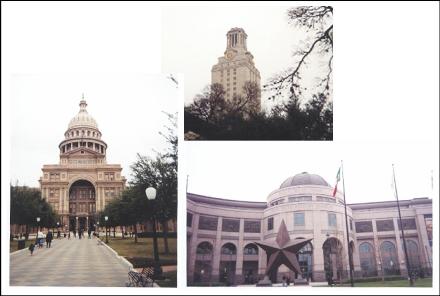
Like Madison, Wisconsin, featured in my entry immediately prior to this one, Austin hosts a huge, state university flagship campus, the state capitol building, and state historical society/museum. Pictured below is a collage of the famous Texas Tower from the UT campus, the Texas capitol building, and Texas State History Museum, all located in close proximity to each other.


Downtown Austin and environs have a lot going on, all within walking distance (if you like a good walk). Austin is the self-proclaimed "Live Music Capital of the World" and home to the PBS music show Austin City Limits. Many visitors will want to go into some of the clubs on Sixth Street, but it's fun even to just walk up and down the blocks, which allows you to hear a new band's music coming out the front door every several seconds.

Another great thing about Austin is its relatively new airport, converted from the former Bergstrom Air Force Base. It's one of the most attractive airports I've ever seen, and has plentiful shopping venues, all, I'm told, based in local businesses.

[UPDATE: I visited UT-Austin again in 2009 and have some photos of that trip.]

Wednesday, August 09, 2006

University of Wisconsin-Madison -- July 2004

The University of Wisconsin-Madison, in my opinion, represents the best combination I've seen of aesthetics, blending of a university and town, and walkability. I visited "Mad-Town" twice in the late 1980s while I was in graduate school at the University of Michigan, and did not get back until 2004, when I attended an academic conference.

The central area of Madison is an isthmus, defined by the Wikipedia as "a narrow strip of land that is bordered on two sides by water and connects two larger land masses."

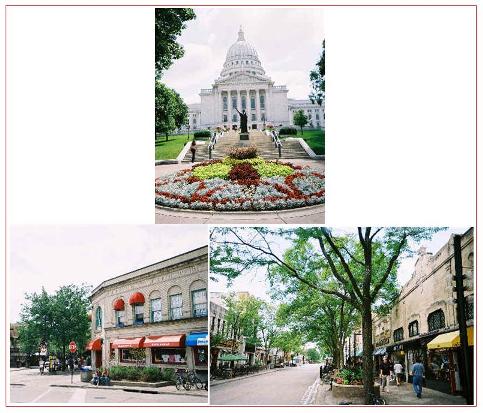
On one end of the isthmus is the Wisconsin State Capitol building and at the other, just blocks away, is the UW campus. Between the two is State Street, an automobile-free pedestrian mall. Here are some shots I took of the capitol and State Street.


When entering the campus via State Street, one encounters a traditional-looking quad, as seen in the bottom photo of the following set...


The little red arrow is pointing to the Wisconsin Historical Society, a straight-on view of which is shown directly above the arrow.

The little green arrow is pointing to the student union, a more direct shot of which is shown above that arrow. The back of the union faces Lake Mendota, one of the two bodies of water forming the isthmus. As can be seen, the union offers lakefront dining and entertainment (notice the stage).

The other body of water in the area is Lake Monona, where a lovely new conference center called Monona Terrace is located. One night at the conference, dinner was served in the glass-enclosed portion of the facility, then we had dessert up on the roof.

Note: I have added some new photos of the University of Wisconsin and the town of Madison from my recent (July-August 2007) visit, which are available here.

Monday, August 07, 2006

Northwestern University -- August 2002

With my sister and other relatives living in the Chicago area, I visit the Windy City on a roughly annual basis. One thing I always try to do is get to the Evanston campus of Northwestern University.

Northwestern is one of the most paradoxical universities in the nation, in my view. It is an academic powerhouse, ranked No. 12 for overall undergraduate education by U.S. News & World Report, for example.

Yet, I expect many would agree that the facilities are not up to what would be expected for such a great institution. Much of the campus is beautiful, modern, or both. But, as you'll see in a photo below, some departments and programs are located in old houses across the street from the core campus. Even on the main campus, some buildings are not state of the art. Part of the problem may have to do with space -- being on the lakeshore, there is a physical limitation of land. In fact, the Evanston history page linked above notes that, "In the 1960s Northwestern expanded its property by constructing a 74-acre landfill, altering the Lake Michigan shoreline." I've also been told that some buildings have been designated as historic sites, thus preventing their removal or renovation.

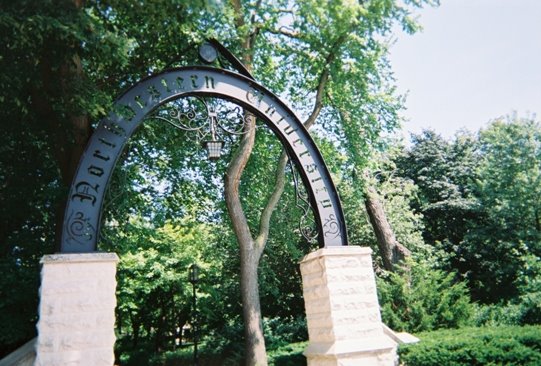
With my background introduction now out of the way, here are some shots of the Northwestern campus. What better place to start than this gate, the symbolic, if not literal, entrance to the campus?


The campus also contains what, to my untrained eye, looks to be Gothic architecture.


The Department of Statistics, shown next, is but one of a row of house-based academic units spanning along Sheridan Road (another being the Institute for Policy Research).


Finally, as can be seen throughout this blog, many of my campus visits have a sports tie-in. When the above photos were taken in August 2002, collegiate competition would have been on summer vacation. I've visited Northwestern a couple of times since then, however, and during my May 2006 trip, I took in some softball action, photos of which are shown on my softball blog. Northwestern ended up finishing second in the nation at the 2006 NCAA Women's College World Series.

Thursday, August 03, 2006

Stanford University -- June 2003

As with my previous entry (below) on the University of Oregon, my trip to Stanford was in conjunction with a Track & Field News tour, to the 2003 USA national championships.

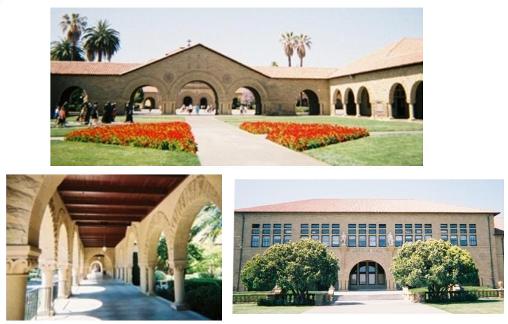
I've found when conversing with people about attractive college campuses that Stanford is frequently mentioned. The beige-brick style of the buildings, red-tile roofs (or is it "rooves"), and abundant use of arches give Stanford a very distinctive look, as shown in the following pictures (on which you can click to enlarge them).


Don't get me wrong -- Stanford's is a nice-looking campus. However, I did not feel mesmerized by the aesthetics and ambience. While visiting with a couple of my former Michigan psychology professors who had moved to Stanford, we agreed that Stanford did not have the "buzz" of energy and excitement that Michigan has. In large part, this is because the UM campus blends seamlessly with the Ann Arbor community, whereas Stanford's size and clear demarcation of its perimeter left me feeling distant from its Palo Alto surroundings.

A better parallel may be between Stanford and Texas Tech, where I'm on the faculty. No less an authority than Red Raider basketball coach Bob Knight, whose son Tim went to Stanford, told a story on Larry King Live (transcript) about how they thought the Texas Tech campus looked similar to Stanford's. You can judge for yourself (albeit based on a small number of photos) by comparing the Stanford shots in this entry to pictures of Texas Tech I posted in an earlier one.

This entry wouldn't be complete without a photo from the track meet, so here's one of Texas Tech's Jonathan Johnson in the men's 800 meters (second from the right, wearing red).

Tuesday, August 01, 2006

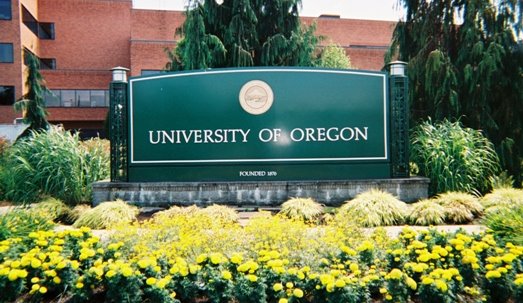
University of Oregon -- June 2001

One of my favorite sports is track and field (for which, believe it or not, I don't have a blog). The magazine Track & Field News organizes tours to major meets, and I've gone on a few of them. One of the meets I went to with T&FN was the 2001 USA national championships, at the University of Oregon in Eugene. In fact, Eugene calls itself "Track Town USA," and there are establishments with names such as "Track Town Pizza." Here are some photos I took on that trip.


As is typical for the Northwest, UO's campus is very lush and green, with a mixture of old and new buildings (the photos below are kind of small, but you can click on them -- or any others -- to see a larger version).


On the athletic side, here's a picture I took at the meet. Leigh Daniel, a former student of mine at Texas Tech, is shown on the far left of the pack in the women's 10,000 meters.


More recent information on Leigh is available here and here.

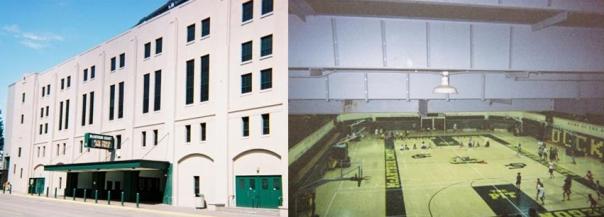
I also went by the legendary McArthur Court, also known as "The Pit," which is the home of Duck basketball. It was open, so I went in. The seating area takes the form of overhanging decks. The only problem (as shown below right) is that the decks hang so low, the view from the lower level is obstructed. I'm all for tradition, but in the case of Oregon basketball, it's probably time for a new arena!

Thursday, July 27, 2006

The Ohio State University -- May 2005

The weekend of May 19-22, 2005, I visited The Ohio State University to attend the U.S. Conference on Teaching Statistics (USCOTS). While there, I also gave a talk to the Group for Attitudes and Persuasion on the Election '04 Study I organized, visited the Ohio Statehouse (state capitol), attended a Buckeyes' baseball game, and went into the Jack Nicklaus Museum (adjacent to the baseball stadium on campus). You might say I like to get the most out of my trips!

I took a lot of pictures at Ohio State. In order to have this website load relatively quickly, however, I try to hold it down to three or four pictures per entry. What I did here, therefore, is edit sets of pictures into collages in PowerPoint, then save each collage as a singular photo. You can click directly on the photos below to make them bigger.

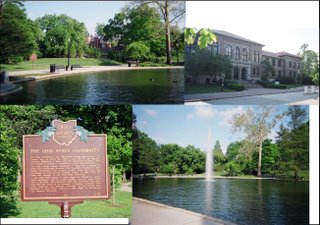
One lovely area of the campus includes Lazenby Hall, home of the social psychology program, and Mirror Lake. There's also a campus historical marker, which can be seen in the lake photos on the left-hand side.


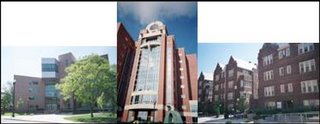
The OSU campus was just teeming with what appeared to be new buildings, a sign of the university's vitality. The building on the left, below, is the new Physics Research Building, which I took note of because of my layperson interest in physics.


No trip to Ohio State would be complete without the famous "Horseshoe," also known as Ohio Stadium (and I say this as someone who's grown critical of the violence and injuries in football over the years). Also, back in the spring of 1984, when I visited OSU to look at it for graduate school (I ultimately chose Michigan instead), the OSU social psychology program was located under the stands in an office component of the football stadium.
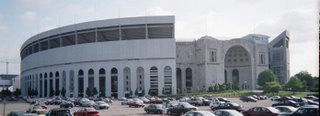


I had posted a set of OSU photos in a different location previously, which was discovered by someone named David Burns. He e-mailed me some web links with historical information on Ohio Stadium and its design (well worth a look).

I also like to show a little bit of the area surrounding a given campus, which ideally will mean plenty of pizza places and bookstores! As some of my Texas Tech colleagues who previously spent time at Ohio State had told me before my trip, the campus is ringed by a number of local establishments and very few national franchises. Among those I visited are captured in another collage I made...
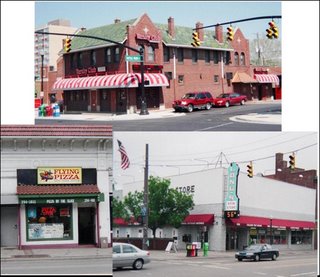


Flying Pizza and Long's Bookstore (as of the time I photographed it) are both on High Street, on the eastern border of the campus. The Varsity Club is on Lane Avenue, on the northern border, by the athletic facilities. As of my visit, Long's was slated to be moving south a few blocks, part of being blended into a huge new Barnes and Noble's.

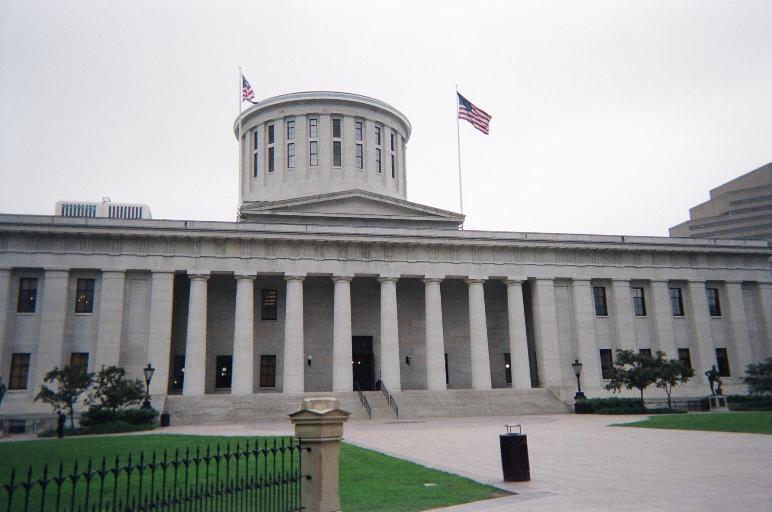
Finally, here's a shot of the state capitol building in downtown Columbus; it can be reached easily by a bus that goes down High Street.

Wednesday, July 19, 2006

Indiana University Bloomington -- May 2006

Two months ago, I attended a conference on networks at IU Bloomington. I had visited previously in the spring of 1984 to consider Indiana for graduate school, but after 22 years, I really didn't remember much about the campus or town, other than that I had had a favorable impression of both.

On my return visit in 2006, the campus and town didn't disappoint (by "town," I refer to the restaurants, shops, etc., catering to the college community and not the residential parts). In fact, the campus and town were contiguous, which is not always the case around the country.


Coming up Kirkwood St., which seemed to be the "main drag," one enters campus at the Sample Gates (at some point IUB will presumably put in real gates, just kidding).


Just about anywhere, the student union plays a major role, although on some campuses more than others. Here in Hoosier land, the Indiana Memorial Union plays a huge role, as it is said to be one of the largest student unions in the world.

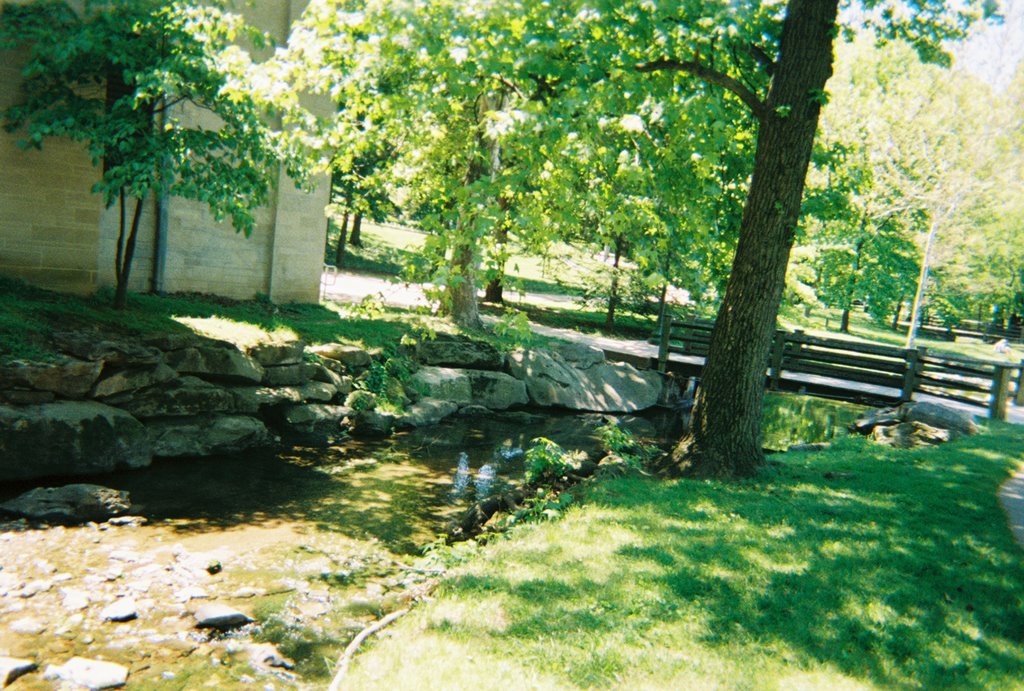
Another thing about the IUB campus that is lovely, but which initially made it hard for me to find my bearings, is that large amounts of space are devoted to natural beauty (e.g., trees, grass fields, streams), befitting of a national or state park. One example is shown below...


The campus seems to alternate between clusters of academic buildings and these open spaces; thus, when as a newcomer you find yourself in the middle of the nature areas, it can be hard to get oriented again as to where the buildings are. Also, other than on one side (by the hotel component), the huge Indiana Memorial Union complex has no signage. I spent a half hour trying to find the IMU on the first day of the conference, only to learn that I had walked by it several times unknowingly.

On the whole, though, Bloomington is a neat town, and IUB, a great campus.

Tuesday, July 18, 2006

University of Southern California -- Guest Photographer

After I posted a notice about my Texas Tech photo display on the RaiderPower.com chat site (the school's sports teams are known as the Red Raiders), someone who goes by the moniker "Raider Aficionado" commented about being at the University of Southern California recently and posted some pictures he or she had taken of the USC campus (the University of South Carolina also, of course, goes by USC). Raider Aficionado also kindly stated that I could use the photos for this blog, and so I'm posting some of them (as can be seen in all of my earlier postings, I'm generally limiting the number of photos per campus to three or four, so that the page will come up relatively quickly on most computers).


The central icon of the Southern Cal campus, of course, is the statue of Tommy Trojan, the school's athletic mascot. As documented here, Tommy needs to be protected from possible mischief by supporters of cross-town rival UCLA in the days leading up to the schools' annual football showdown.
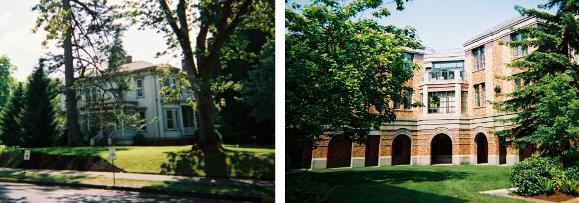


Next is a shot of the Student Activities Center, which I believe Raider Aficionado took to illustrate the abundant trees on campus as much as the center.


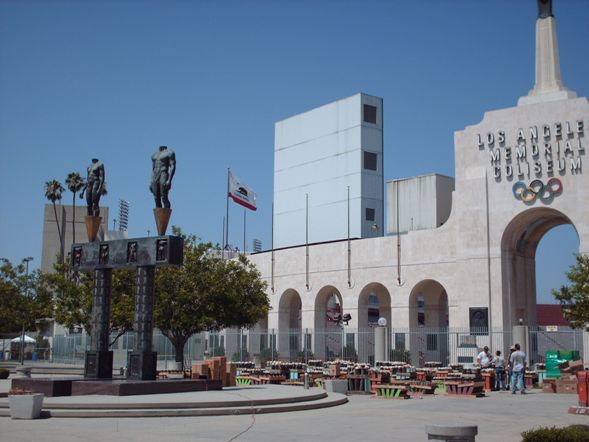
Finally, we have the L.A. Memorial Coliseum, located within walking distance of USC. In addition to being the home of the Trojan football team, the Coliseum has hosted two Olympics (1932 and 1984) and used to host L.A. Rams (now in St. Louis), L.A. Raiders (now back in Oakland), and UCLA Bruins (now at the Rose Bowl) football games. Also in the athletic realm, after many years of playing at the decaying L.A. Sports Arena near campus, the Trojan basketball teams will inaugurate a new on-campus facility, the Galen Center, this season.