Monday, August 03, 2009

Washington DC Schools I: Georgetown University

I've just gotten back from Washington DC, where I attended the annual Society for American Baseball Research (SABR) conference. I took some time last Friday afternoon to visit and photograph four universities in the District, all via subway, bus, and walking (including a non-stop walk from American University to Georgetown). Luckily, an afternoon rainstorm cooled things down and then dissipated, making it fairly pleasant to get around.

Let's start our series on the DC campuses with Georgetown University. Not only is Georgetown an academically elite institution (with alumni including Bill Clinton, at the undergradute level), but the surrounding neighborhood is also extremely famous. Below are a couple shots of the campus (from the 37th St. side), which my fiancee Sylvia tells me features Gothic architectural style.


Also visually interesting is the adjacent residential neighborhood, featuring an array of pastel-colored townhouses. Somewhat reminiscent of San Francisco (although with much less severe incline), one must go down a hill to get to the "main drag" commercial area.


The hub of the commercial district is the intersection of M Street and Wisconsin Avenue, NW (under L'Enfant's design for DC's street system, letter-based streets go east-west, numbered streets go north-south, and streets named after states run diagonally). Most of the stores and restaurants in Georgetown -- which appear to cater primarily to an upscale clientele -- run along M Street. That includes an Uno's pizza, at which I dined.

Nearby, running roughly parallel to M Street is the Potomac River, on the other side of which are a number of glitzy buildings in the Virginia suburbs. Washington's excellent Metro subway system does not run in Georgetown, but one can catch buses on M Street going to the subway.

Tuesday, June 30, 2009

The Ohio State University


At The Ohio State University, Buckeye spirit reigns supreme (including the famous dotting of the "i" in Ohio, as depicted in the statue above). OSU hosted this year's biennial U.S. Conference on Teaching Statistics, as it also did in 2007 and 2005. I have attended all three of these conferences and took some pictures this year to supplement the ones I took in 2005.

Two major buildings on any college campus are the main library and the student union. When I visited in 2007, construction had begun on renovations of both these structures. Now, two years later, both are nearing completion. The library, shown immediately below, is scheduled to open during this coming fall term.


Two of the prettier sights on the OSU campus are located between the library and the student union. One is Mirror Lake...


...and the other is the Oval. The only way I could think of to convey the scope of the Oval with my photos was to juxtapose two adjacent areas (this photo from the university's official website does a better job).


With its imposing presence, the Oval reminds me of another great expanse of green, The Lawn at the University of Virginia.

From the eastern end of the Oval, it is a short walk to High Street, which not only forms part of the OSU campus perimeter but also is one of the major thoroughfares in the city of Columbus (see this online historical slide show of High Street).

Walking south on High, one comes across the construction site of the Ohio Union, which is scheduled to reopen in 2010. The following pictorial sequence shows what the front of the union will look like from north to south.


Continuing southward on High Street, one would then encounter the South Campus Gateway, a business development that I first saw in 2007. The Gateway is anchored at one end by former Buckeye football great Eddie George's restaurant...


...and at the other by a huge Barnes and Noble bookstore and movie theatre complex (the latter is not shown).


In what I think is a nice touch, the light-blue sign from the old Long's bookstore (which was located a few blocks north on High Street) is preserved at Barnes and Noble, as shown above. Also shown is an advertisement for a bicycle-riding event with Lance Armstrong to raise money for cancer research at OSU (the name of the event appears to derive from the cycling term, peloton).

Shifting considerably west, one can say of the OSU campus that "a river runs through it," the Olentangy River to be exact. On one side of the river is the legendary Ohio Stadium football palace (shown in my 2005 photos) and most of the rest of the campus. Among the structures on the other side are a number of athletic facilities, including Value City Arena/Schottenstein Center (shown in the distance immediately below in my river pictures).


Lastly, from just south of Ohio Stadium, one gets a look at the "skyline" of the OSU Medical Center.

Monday, June 22, 2009

University of Illinois (2009)


Erika Brooks, one of our Texas Tech graduate students, recently traveled through the Midwest. She has kindly allowed me to display some photos she took at the University of Illinois, Urbana-Champaign, which are cross-posted from her Facebook page. Illinois is one of only three Big Ten schools I've never been too, so it's nice to have Erika's photos. First, to the right, we have the new McFarland Bell Tower, which is described in this article. I did a little research in preparing this write-up and learned that UIUC already has a bell tower by Altgeld Hall. Now students will have to be more specific than just saying, "I'll meet you at the bell tower."

Next, Erika provides us with a crisp, beautiful shot of the Illini Union, which looks really quaint. You've got to love a student union that has a bowling alley.


Lastly, there's a shot of a campus entrance. It's a little fuzzy; perhaps it was taken at a distance.

Friday, June 12, 2009

University of North Carolina

Whether it's the picturesque scenery, the Tar Heel sports teams' signature powder blue motif, or the bars, restaurants, and shops of Franklin Street, the University of North Carolina-Chapel Hill is one of the nation's most vibrant institutions of higher education. I recently had the opportunity to make my first visit to UNC (to the state of North Carolina, overall, in fact) to attend an academic conference. Naturally, I took the opportunity to walk around the area and take some pictures.


If I had to describe UNC in two words, they would be traditional and green. The campus also has a consistency of building style, featuring red brick, which I think adds to a school's appearance. Below are large photos of two buildings, plus a montage of additional ones.


The aforementioned Franklin Street is the commercial hub of the UNC area, extending several blocks in either direction from the East/West dividing point. Featuring restaurants to fit a wide array of tastes, coffee houses, ice cream parlors, and, of course, plenty of stores to buy Tar Heel clothing and paraphernalia, Franklin Street compares favorably in my mind to other "main drag" college-town streets around the nation.


Few (if any) college-town thoroughfares would be able to exceed Franklin Street's volume and variety of establishments, I would guess. One downside, however, is walkability. Unlike Madison, Wisconsin's pedestrian-friendly State Street, for example, from which automobiles are banned, Franklin Street is five lanes wide, with plenty of cars zooming by. Thus, you'll probably spend a fair amount of time waiting for "Walk" signs at intersections.

There probably aren't many U.S. cities in which you'll see fire trucks painted Tar Heel blue, though. Chapel Hill naturally is one of them!


Finally, by coincidence, today's New York Times ran its weekly "36 Hours in..." travel feature on North Carolina's Research Triangle region, which includes Chapel Hill. A couple of Franklin Street eateries were mentioned, as was the Carolina Inn, which hosted the conference I attended.

Thursday, June 11, 2009

University of California, Riverside

Sothy Eng, a graduate student with us at Texas Tech and a superb photographer, was kind enough to let me post some photos he took on a visit to the University of California, Riverside on this blog. Sothy's pictures are concentrated around the "HUB" (which stands for Highlander Union Building). UCR is a relatively new institution as far as major universities go, having been established in 1954, and there's also been a lot of recent construction on campus. Here are Sothy's shots, which also feature UCR's clock tower (only a tiny amount of which consists of the clock) and verdant, flowery setting.


Saturday, February 14, 2009

Florida State University


Downtown Tallahassee is home to the Florida capitol building (above), the most noteworthy feature of which is probably the display of dolphin statues at the front (also shown enlarged). I took this photo standing in front of another somewhat famous building, the Florida Supreme Court, while in town to attend an early February academic conference at Florida State University. From downtown, one can also see FSU's Westcott administration building in the distance (circled in the next photograph).


As one approaches the FSU campus, either on wheels or on foot, one finds a university that looks like it belongs in, well, Florida. The campus is very green, with a variety of trees, including palm.


As the host of the conference informed the visitors, the signature area of the campus is Landis Green and the associated Legacy Fountain (photos below).


Finally, we have the FSU bookstore complex, which is located right by -- but not actually in -- the student union area.

Saturday, February 07, 2009

University of Texas (2009)


In mid-January, I attended an academic conference at the University of Texas-Austin. The last time I was in Austin, five years ago, I took pictures mainly of the downtown/capitol area, rather than the campus.

This time, I focused more on the campus, including the famous Texas Tower (shown at right).

Given the location of the conference in the Seay Building (which houses psychology and other social science disciplines) in the northwest corner of campus, my pictures are concentrated in this area. The next three photos show the Seay Building from different perspectives, including the garden in the center of the complex...


A building across the street from Seay that attracted my attention is Neural Molecular Science.


Finally, I took a picture of the UT bookstore (the Co-op) on Guadalupe, which appears to be the "main drag" of the campus area.

Tuesday, November 11, 2008

University of Virginia

Frequent contributor Jackie Wiersma, now doing a postdoctoral fellowship at Penn State, traveled recently to the University of Virginia in Charlottesville, from which she's sent some pictures.

I've been to UVa a couple times, years ago. My brother Steve went there and my family visited with him during his first year and also attended his graduation. My department chairperson at Texas Tech, Anisa Zvonkovic, also attended UVa for her undergraduate education.

Virginia is one of the nation's most storied universities, having been founded by Thomas Jefferson. So to all you Cavaliers out there, "Wahoowa!" Let's get to Jackie's photos...


Shown first is the Rotunda, a structure so prominent it has its own Wikipedia page. According to that page, "The Rotunda is the symbolic head of The Lawn and the University of Virginia. The Academical Village of which it is a part is one of only four man-made sites in the United States to be named a World Heritage Site by the United Nations Educational, Scientific and Cultural Organization (along with the Statue of Liberty, Independence Hall, and Pueblo de Taos)." It was apparently a cold, gray day when Jackie went to UVa, as a result of which the white dome of the Rotunda is obscured.


The aforementioned Lawn is shown next. Perhaps the most prestigious honor on campus for academic success is for students to be allowed to live in the housing units forming the perimeter of the Lawn (a close-up of the residential area is inserted in the lower-left corner).

We leave you with three more buildings: the Student Union (Newcomb Hall), a free-speech-type area, and the Old Medical School.


Tuesday, April 08, 2008

Texas A&M University

In February, I visited Texas A&M University in College Station (see here for background on my trip). A&M, in southeast Texas, is almost diametrically apart from where I am at Texas Tech, in the northwest portion of the state.

Upon my return, Dinah Harriger, who did her undergraduate work at A&M and is now a graduate student in Texas Tech's highly regarded Marriage and Family Therapy program, assisted me in identifying the campus landmarks in the photos I took (it took a little while for us to coordinate our schedules, hence the delay). She also drew my attention to online information about these landmarks.

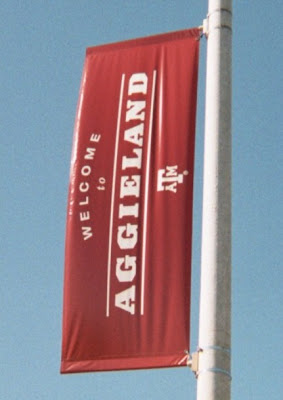

In addition to Aggie tradition, A&M is also rich on welcoming signs, as seen in the first two photos. Shown above is the Aggieland water tower, whereas to the right is one of the banners gracing the edge of campus. You'll see plenty of maroon and grey if you visit Texas A&M!


Immediately below this text is a wide shot of the Simpson Drill Field, with some academic buildings in the background. This document from the Brazos County Historical Commission provides a detailed history of the Drill Field and A&M's role in military training (see the next-to-last paragraph on the BCHC page). The Drill Field is somewhat reminicent of Ohio State University's Oval and the University of Virginia's Lawn.


Just off the Drill Field is the Albritton Bell Tower. For an evening shot of the Tower and some physical details about it, check here.

The Albritton Bell Tower, erected in 1984, has also been the site for a solemn tribute to the 12 people who died in the 1999 bonfire collapse.

The next three photos down are from the athletic part of campus. Kyle Field is one of college football's most celebrated venues, with its triple-deck configuration, 12th Man tradition of students standing the whole game (and of couples kissing after every Aggie score), and walk-on kick-off coverage team for A&M (a practice that has been modified by successive Aggie coaches).


As with other large university campuses in Texas, A&M is not always very pedestrian-friendly, with some kind of major thoroughfare bisecting Kyle Field from the adjacent part of campus. Shown below is the underground tunnel one must walk under, to go to or from Kyle Field. There are signs warning bicyclists to yield to pedestrians. Thinking that there must be a reason for these signs, as I walked under the tunnel, I kept looking around in all directions in case any would-be Lance Armstrongs might roar past me.


On the other side of the tunnel from Kyle Field is Reed Arena (below), one of the Big 12 conference's newest basketball venues. Inside, Reed is similar to Texas Tech's United Spirit Arena, in that both have two seating decks. The difference is that the USA is double-decked on all four sides, whereas Reed's upper deck only covers three sides, with the remaining side (behind one of the baskets) an open wall.


Lastly, I always make it a point to get to the "college town" area adjacent to a given campus. On the University Drive side of campus, one finds a mixture of quaint store structures and modern-day franchises such as Domino's Pizza, Potbelly Sandwiches, and Starbucks Coffee (shown below).


I hope my fellow Red Raiders at Texas Tech don't hold this against me, but I found Texas A&M a nice campus to visit!